


How to Keep Asthma Under Control
Bronchial asthma may not remind you of itself for years, while still remaining an active chronic disease. Why spirometry is important, how to recognize…



The administrator of VIRTUS will contact you shortly

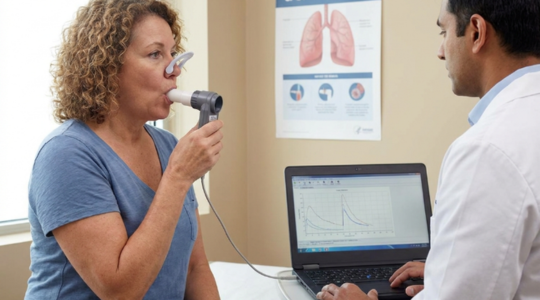
Spirography is one of the most important methods for assessing lung (external respiratory) function; it helps detect pulmonary diseases at early stages. The examination is quick, painless, and informative.
Spirography (or spirometry) is a method for studying the function of external respiration. Different medical institutions may use different names, but they refer to the same examination.
The primary goal of spirography is to evaluate how the lungs and airways work and to detect impairments of external respiratory function in patients with respiratory diseases. Spirometry is one of the «gold standards» for diagnosing bronchial asthma because it allows detection of bronchial obstruction and assessment of whether it is reversible. Sometimes a person feels no breathing problems, yet spirometry already shows impaired lung function. That is why the test results help identify asthma before pronounced symptoms appear and start treatment in a timely manner.
Spirography shows how external respiratory function works and how well the lungs perform their job. First and foremost, the test helps detect the presence of bronchial obstruction and determine whether it is reversible. Spirography also allows assessment of treatment effectiveness: if measurements improve after therapy is prescribed, this indicates that the treatment was appropriate and the disease is responding positively. The test can reveal impairments even when a person has no complaints, which makes it possible to adjust treatment in a timely manner.
Spirography helps determine the degree of changes in chronic obstructive pulmonary disease (COPD), which is important for selecting the correct treatment strategy. Spirometry results are also used in preoperative evaluation to assess the functional state of the respiratory system and to reduce risks during anesthesia.
Like any procedure, spirography has its indications and contraindications.
Indications for spirography include:
Spirography is a safe method and well tolerated by most patients. However, performing it temporarily increases intrathoracic, intra-abdominal, and intracranial pressure. Therefore, in some cases the examination is carried out with caution.
Relative contraindications for spirography include:
After examining the patient, the doctor determines whether spirometry can be performed in the specific case.
Spirography is a widely used diagnostic method that has been employed for many years. According to current medical protocols, general practitioners, family doctors, and pediatricians should have the skills to perform spirography.
However, it is not enough merely to perform the test and interpret the results. They must also be correlated with the patient’s clinical picture and medical history. For this reason, the interpretation of spirography results and the prescription of treatment should be done by a specialist — a pulmonologist or an allergist. At the VIRTUS clinic, consultations are led by a pulmonologist with over 33 years of experience — Viktor Yakovych Stukanov. The doctor performs spirometry and prescribes treatment on an individual basis.
Spirography is one of the most important methods for diagnosing respiratory system diseases, since it can reveal impaired lung function even when the patient does not yet have pronounced symptoms. The test is used to diagnose bronchial asthma, chronic obstructive pulmonary disease (COPD), cystic fibrosis, pulmonary fibrosis, and other respiratory system disorders.
A pulmonologist can properly perform spirography and correlate its results with the patient’s medical history.
The cost of spirography in Odesa depends on the type of test. Standard spirography is less expensive, while a test with a bronchodilator challenge is more costly because it includes additional drug administration and repeat measurements. At VIRTUS the examinations are performed on modern equipment, and the results are analyzed by an experienced pulmonologist.
Spirography is a painless procedure. However, during the test patients may experience weakness, dizziness, fatigue, or a brief cough triggered by the intensive inhalation. These symptoms usually pass quickly. If the patient has a history of myocardial infarction, a temporary increase in heart rate is possible.
The duration of the test depends on its type and takes up to 30 minutes.
Thank you to the doctor for the high professional standard of care.
I periodically have ultrasounds at VIRTUS with Yuliia Yuriivna Hrysiuk. She is very thorough, answers all my questions, and never makes me feel rushed, even when there is a queue. The reception staff are friendly, and the service is comfortable. Thank you!
The visit went well. I received a comprehensive consultation from Yuliia Yuriivna Hrysiuk. The appointment started on time, and I am satisfied with the clinic’s service.
To ensure a successful examination, follow these recommendations before the test. Preparation for spirometry includes:
Also inform the doctor if you take any medications regularly and clarify whether you should take them on the day of the examination.
During spirography the patient performs specific breathing maneuvers under the supervision of a healthcare professional. The stages of performing spirometry are as follows:
The test is performed three times in succession to obtain the most accurate results. Spirography for the diagnosis of bronchial asthma is conducted as follows:
After the examination is completed, the doctor interprets the results obtained and, if necessary, prescribes additional tests or treatment.


Leave an application for an appointment at the clinic
We thank you for contacting the VIRTUS Institute.
The administrators will contact you shortly to clarify the details of the visit.

 355
355  4 min.


 Submit your review
 Ask a question


Leave an application for an appointment at the clinic
We thank you for contacting the VIRTUS Institute.
The administrators will contact you shortly to clarify the details of the visit.
Just leave your phone number - we will book you in within 1 minute.

We will definitely take your feedback into account to improve the quality of work and improve the standards of service of the Institute of Advanced Medicine “VIRTUS”. Have a nice day!
We invite you to review feedbacks on a special page, which contains video and text feedbacks from the site and the VIRTUS guestbook..
Every day we work to improve the quality of work and the standards of the VIRTUS Institute, and customers’ recognition is the most valuable asset that we are proud of!

Your question will be addressed to the VIRTUS subject-matter specialist.
Your question will be addressed to the VIRTUS subject-matter specialist. The answer will be sent to the specified e-mail, as well as to the “Questions and Answers” page without specifying your data
We hope you find it interesting and useful to study what questions were asked by other clients and patients of the VIRTUS Institute:
Write a phone number and we will help.
